
PART 1 OF THE GOAT The Greatest Cyclist Of All Time
- Andrew Livingstone
- Jun 9
- 3 min read

Comparing the Maximum Power of Eddy Merckx and Tadej Pogačar

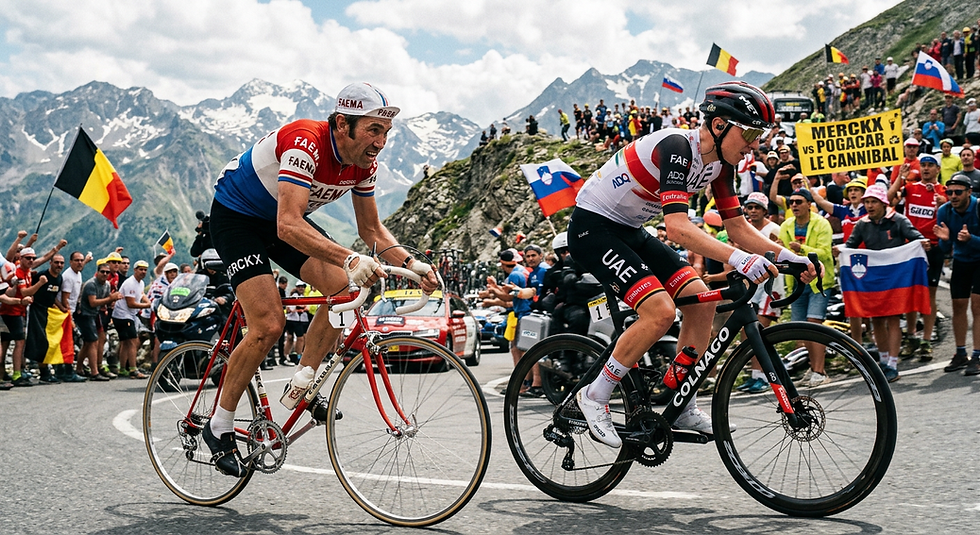
Few comparisons in cycling are as intriguing as putting Eddy Merckx and Tadej Pogačar side by side. Who is the greatest cyclist of all time? Both are all-round champions capable of winning grand tours, classics, and time trials, but they raced in very different technological and scientific environments. Because Merckx rode long before modern power meters, any number for him is necessarily historical or estimated, while Pogačar’s figures come from modern race analysis, training disclosures, and publicly discussed data. That means the fairest comparison is not to pretend the numbers are equally precise, but to examine what each rider’s maximum reported power tells us about the kind of athlete he was.
Eddy Merckx: The Benchmark from a Pre-Power-Meter Era
The most frequently cited maximum-style power figure for Eddy Merckx is a 1975 ergometer test in Cologne in which he reportedly sustained 455 watts for an hour. If accurate, that is an astonishing endurance output and helps explain why Merckx dominated so many kinds of races. It is important, however, to be careful with the claim. The figure is widely repeated in cycling literature and forum discussions, but it does not come with the same transparent documentation that modern riders’ power files provide. In other words, Merckx’s famous number is best understood as a historical marker of elite sustained power rather than a directly verifiable modern data point.
Tadej Pogačar: Modern Data and Multi-Dimensional Power
Tadej Pogačar’s numbers are more varied because modern racing tracks power across many durations. Recent reporting around his training and race performances places his threshold power roughly in the 415 to 450 watt range, depending on the source and method of estimation. Analysts have also estimated that he produced about 435 watts for more than 37 minutes on Isola 2000 and roughly 442 watts for 38 minutes on Plateau de Beille, extraordinary figures given his relatively light body mass. On shorter efforts, reports tied to race data have placed him around 620 watts for more than a minute on the Poggio, with peak bursts near 890 watts, and some broader performance analyses put his five-second peak power around 1,400 watts. Together, those numbers suggest a rider who combines elite climbing endurance with a remarkably high top end for attacks and reduced-group sprints.
Direct Comparison
If the famous 455-watt figure for Merckx is taken at face value, it stands as a higher sustained one-hour number than most public estimates attached to Pogačar. By contrast, Pogačar’s publicly discussed profile shows more detail across durations: threshold estimates in the low-to-mid 400s, high-400-level efforts near threshold, around 620 watts for a decisive one-minute-plus attack, and peak neuromuscular power that may approach or exceed 1,000 watts in short bursts. The key point is that the two riders illuminate different kinds of evidence. Merckx’s reputation rests on a legendary long-duration power claim and on race results that proved he could apply force repeatedly across every terrain. Pogačar’s case is built from a richer modern data trail showing not just endurance, but also explosive power layered on top of elite climbing ability. In pure maximum-power terms, Pogačar appears to have the more clearly documented short-duration peak output, while Merckx’s most celebrated number remains a statement about sustained aerobic power.
Conclusion
The cleanest conclusion is that Eddy Merckx and Tadej Pogačar are both extraordinary, but their power numbers tell slightly different stories. Merckx’s legendary reported 455 watts for an hour captures the image of an unmatched engine from cycling’s older era, even if the documentation is less rigorous than modern standards require. Pogačar, meanwhile, benefits from far more precise measurement, and the available evidence suggests a uniquely broad power profile that stretches from grand-tour climbing intensity to explosive attacks and sprint finishes. Rather than proving one rider categorically stronger than the other, the comparison shows how Merckx embodied overwhelming sustained force in his time, while Pogačar represents the modern ideal of a complete rider with both endurance and high-end peak power.
YOUR GOAT?
EDDY MERCKX
TADEJ POGACAR


Comments