
PART 4 OF THE GOAT The Greatest Cyclist Of All Time

Eddy Merckx’s Bike vs Tadej Pogačar’s Bike: A Cross-Era Comparison

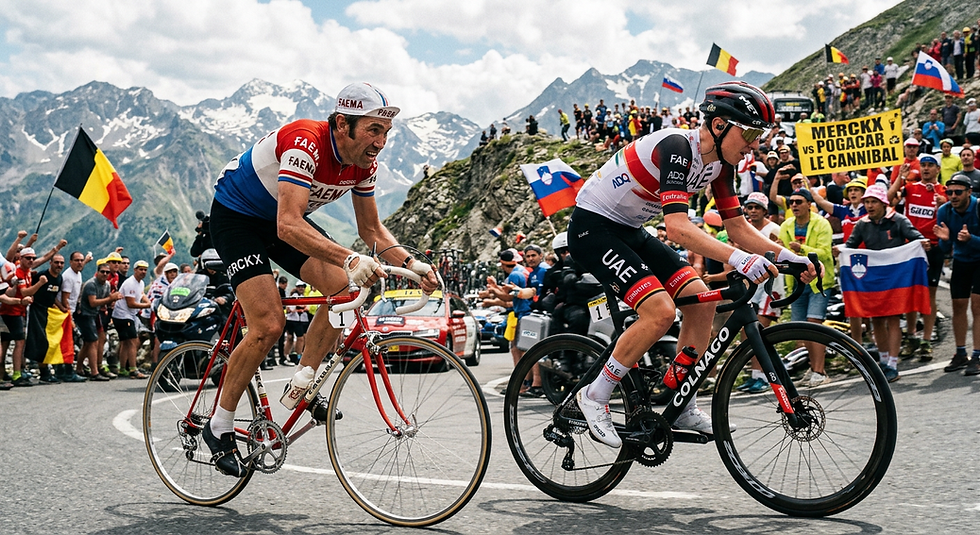
Comparing the race bike of Eddy Merckx with the machine ridden by Tadej Pogačar is really a comparison between two very different eras of cycling technology. Merckx’s best-known road bikes from the early 1970s were handmade steel machines built around Reynolds 531 or similar tubing, fitted with Campagnolo mechanical components, narrow tubular tyres and rim brakes. Pogačar’s modern Colnago race bikes, by contrast, are carbon-fibre monocoque designs with deep aerodynamic shaping, electronic shifting, hydraulic disc brakes, wider tubeless-ready tyres and highly integrated cockpits. Both were elite tools in their own time, but the modern bike is vastly more sophisticated in absolute performance terms.
Materials and Construction
A typical Eddy Merckx team bike from the Molteni period was built from thin-wall steel tubing and lugged construction. Examples documented from the period weigh around 9.8 to 9.9 kilograms when fully built, which was competitive for the time and reflected the priorities of the era: durability, road feel and mechanical simplicity. By comparison, Pogačar’s Colnago V4Rs and Y1Rs use advanced carbon layups to tune stiffness and weight far more precisely. A complete V4Rs build is commonly reported around 7.25 kilograms, while Pogačar’s 2025 Tour de France Colnago Y1Rs has been reported around 7.2 kilograms in race trim, with lighter stripped-down variants near the UCI minimum for specific stages.
Performance Characteristics
The biggest difference between the two bikes is aerodynamics. Merckx’s road bike used round steel tubes, exposed cables and traditional cockpit shapes, all of which created more drag. Pogačar’s Colnago, especially the Y1Rs, is built around modern aerodynamic principles. Reports on the Y1Rs cite roughly a 19 percent smaller frontal area than the V4Rs and a drag saving of about 20 watts at 50 km/h in Colnago’s published comparisons. Even the all-round V4Rs is said to require 5.2 watts less power than its predecessor at 50 km/h for the bike alone, with larger gains when measured together with a rider. In real racing, that translates into easier speed maintenance on flats, stronger breakaway efficiency and more speed for the same power output.
Stiffness and power transfer are also dramatically improved on the modern bike. Merckx’s steel bike would have felt lively and stable, but it inevitably flexed more under heavy sprinting and seated climbing loads than a modern carbon frame. Contemporary reviews of the V4Rs emphasise its stiffness-to-weight ratio, especially around the bottom bracket and front end, while reports on the Y1Rs note about a 3.5 percent increase in out-of-saddle sprint stiffness over the V4Rs. This means Pogačar’s bike is better at converting high peak power into forward motion, particularly in accelerations and late-race attacks.
Braking and handling reveal another enormous generational shift. Merckx raced with rim brakes and narrow tubular tyres, which were state of the art at the time but offered much less stopping power and less wet-weather consistency than modern systems. Pogačar’s Colnago uses hydraulic disc brakes, high-end carbon wheels and tyres up to 30–32 mm wide depending on setup. The result is superior braking control, more grip in corners, better descending confidence and lower rolling resistance on imperfect road surfaces. Modern tyre technology alone gives the current bike a substantial advantage in speed, comfort and fatigue reduction over long races.
Relative Cost in Today’s Money
Estimating cost across eras requires some approximation because Eddy Merckx’s team bikes were not always sold as standard consumer products. One documented period reference notes that a 1974 Kessels-built Eddy Merckx frame was bought in 1975 for 400 Deutsche Marks. Since that was only the frame, a full period-correct racing build with Campagnolo components, wheels and finishing kit would have cost substantially more. A reasonable estimate for a top complete bike in the mid-1970s is roughly 1,000 to 1,600 Deutsche Marks. Using broad inflation and purchasing-power comparisons to 2026, that places a Merckx-era elite racing bike at approximately AU$6,000 to AU$12,000 in today’s money.
Pogačar’s modern bike is considerably more expensive as a retail product. An Australian listing for the Colnago V4Rs Limited Edition Tadej shows a price of AU$28,441, while other international listings place similar special editions at around US$17,500 to US$18,500. That means a top-end modern Pogačar-style race bike costs roughly 2.5 to 4.5 times as much as a top Merckx-era racing bike when both are expressed in today’s money. The extra cost reflects not just inflation but the complexity of carbon manufacturing, disc brake systems, electronic groupsets, integrated cockpits and premium wheel technology.
Conclusion
If the question is which bike is faster in absolute terms, the answer is unquestionably Tadej Pogačar’s Colnago. It is lighter as a complete road-race package, far more aerodynamic, stiffer under load, better at braking and more efficient over a wide range of terrain. But if the comparison is made relative to each era, Eddy Merckx’s bike remains a remarkable achievement: a steel racing machine that represented the peak of early-1970s design and helped define one of the most dominant periods in cycling history. Merckx’s bike was a masterpiece of craftsmanship and racing practicality; Pogačar’s is a masterpiece of modern engineering.


Comments