
PART 3 OF THE GOAT The Greatest Cyclist Of All Time

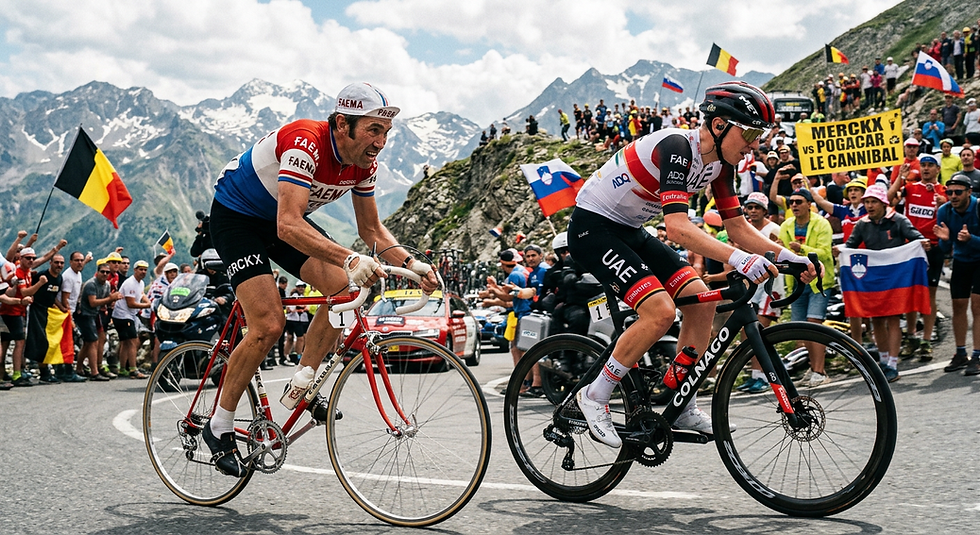
Eddy Merckx vs Tadej Pogačar on the Same Climbs: A Cross-Era Comparison

Comparing Eddy Merckx and Tadej Pogačar on identical climbs is both fascinating and tricky. The obvious challenge is that they raced in very different eras, under different rules, on different equipment, and often on slightly different route designs. So the fairest way to compare them is not to pretend that a single stopwatch reading settles everything, but to look at climbs and race finales both men actually completed, then ask what their performances say about climbing style, explosiveness, endurance, and race-winning impact.
The strongest shared points of comparison are not always long alpine summit finishes. Instead, they are famous race-defining ascents that recur across cycling history: the short, repeated walls of Liège–Bastogne–Liège, the hilly climbing sequence of Il Lombardia, and the steep bergs of the Tour of Flanders. Both Eddy Merckx and Tadej Pogačar won those races multiple times, which gives us a meaningful basis for comparison even when exact split times are unavailable or route details changed year to year.
Which “same climbs” can really be compared?
The most defensible shared terrain comes from races both riders won repeatedly. Merckx won Liège–Bastogne–Liège five times and Giro di Lombardia twice, while Pogačar has already built a similarly imposing record in both races, including multiple victories in Liège and five consecutive wins in Lombardia. Merckx also won the Tour of Flanders twice, while Pogačar has emerged as one of the few modern Grand Tour stars capable of winning on the Flemish bergs. Those races are not identical every year, but their decisive climbs are close enough in character to support a serious comparison. Merckx’s record across the Monuments and Grand Tours remains the benchmark, while Pogačar’s growing tally has already placed him in direct historical conversation with him.
For this article, the comparison will focus on three categories: first, the repeated Ardennes climbs of Liège–Bastogne–Liège such as the race’s steep late ramps; second, the long, fatigue-heavy ascents and hilly sequence that shape Il Lombardia; and third, the explosive cobbled climbs of Flanders, where acceleration and positioning matter as much as raw climbing power. These are not laboratory conditions, but they are the best real-world overlap between two riders separated by half a century.
1. Liège–Bastogne–Liège: repeated steep climbs and the all-round test
Liège–Bastogne–Liège is perhaps the cleanest shared test because its identity has remained stable across decades: long distance, accumulated climbing, repeated steep ramps, and a finale that rewards a rider who can attack after hours of attrition. Merckx won Liège five times, underlining how dominant he was on terrain that demanded far more than pure climbing. Pogačar has made the race look similarly natural to him, using sharp accelerations and sustained power to detach rivals on the decisive climbs and then extend the gap to the finish.
If the comparison is about style, Merckx appears as the rider with the broader diesel engine: he could impose himself through repeated pressure, superior resilience, and the ability to keep producing race-winning force deep into an exhausting day. Pogačar, by contrast, often looks more explosive on the key ramp itself. On a modern Liège climb, his accelerations tend to be sharper and more visibly decisive. On the same kind of ascent, Merckx’s advantage would likely lie in cumulative attrition; Pogačar’s in instantaneous separation. Over an entire Liège course, both profiles are devastating, but they express dominance differently.
2. Il Lombardia: long climbs, repeated surges, and late-race endurance
Il Lombardia offers a different kind of common ground. The exact route has evolved, but the race has always rewarded elite climbing after a long, draining day in northern Italy. Merckx won Lombardia twice; Pogačar has turned it into a personal domain with five straight victories. That alone suggests something important: whatever the era, this is a race for riders who can survive repeated climbing, attack with precision, and still have the composure to finish the job when everyone else is already at their limit.
On long Lombardia climbs, Pogačar probably has the clearer edge in pure modern climbing efficiency. His seated accelerations, high power-to-weight profile, and ability to surge repeatedly on steep gradients make him look almost custom-built for this terrain. Merckx, however, brought something more totalising: he did not merely climb well, he arrived at the climb after already having worn the race down. If both men were placed on the same Lombardia ascent in the same race conditions, Pogačar might produce the more explosive single-climb effort, but Merckx might reach that climb with the field already more broken because of everything he had done beforehand.
3. Tour of Flanders: short climbs, steep gradients, and punch under pressure
At first glance, Flanders might seem less relevant to a climbing comparison, but the bergs are exactly where this duel becomes interesting. These are short, violent ascents where traction, timing, and explosive force matter more than sustained alpine rhythm. Merckx won the race twice and remains one of the few riders in history who could dominate both Grand Tours and cobbled Monuments. Pogačar has proved he belongs in that tiny club too, winning Flanders despite being built primarily as a stage-race superstar.
On the same steep cobbled climb, Pogačar may actually be easier to imagine as the faster rider in a modern, measured comparison: his punch is immediate, violent, and highly repeatable. Yet Merckx’s greatness lies in the fact that he could do this while also being the era’s supreme stage-race engine and time trial force. If the question is who looks more explosive on a single berg, Pogačar has a strong claim. If the question is who brings the larger all-day physical threat into every climb that follows, Merckx still has the more overwhelming historical profile.
How fair is a direct performance comparison?
Any claim that one rider was definitively “faster” on the same climb needs caution. Merckx raced with heavier bikes, less scientific nutrition, less aerodynamic equipment, and very different team tactics. Pogačar benefits from modern training methods, pacing data, lighter machinery, and a sport that has become more specialised. Exact climb times also depend on weather, road surface, tactical context, and whether the climb was ridden as a launchpad, a control section, or a full-gas finish. That is why race-winning authority matters more here than raw stopwatch mythology.
The Greatest Cyclist Of All Time
The Verdict
On the shared climbs and climb-defined races both men completed, the comparison comes down to the shape of dominance. Eddy Merckx looks like the more relentless total-race destroyer: a rider who could arrive at the decisive ascent after already emptying the field through distance, pressure, and all-round superiority. Tadej Pogačar looks like the more visibly explosive modern climber, especially on steep ramps and late-race accelerations. If the question is who had the greater all-time body of work on climbing terrain, Merckx still leads comfortably. If the question is who appears more surgically lethal on the decisive climb itself, Pogačar often looks closer to the modern ideal. The most honest conclusion is that both are exceptional on the same kinds of climbs, but they win them in different ways: Merckx by total domination of the race, Pogačar by making the decisive climb his finishing weapon.


Comments