
Two Leaders, One Yellow Jersey

Red Bull–Bora–Hansgrohe are taking two captains to Barcelona. History says that’s brave, brilliant — or both.
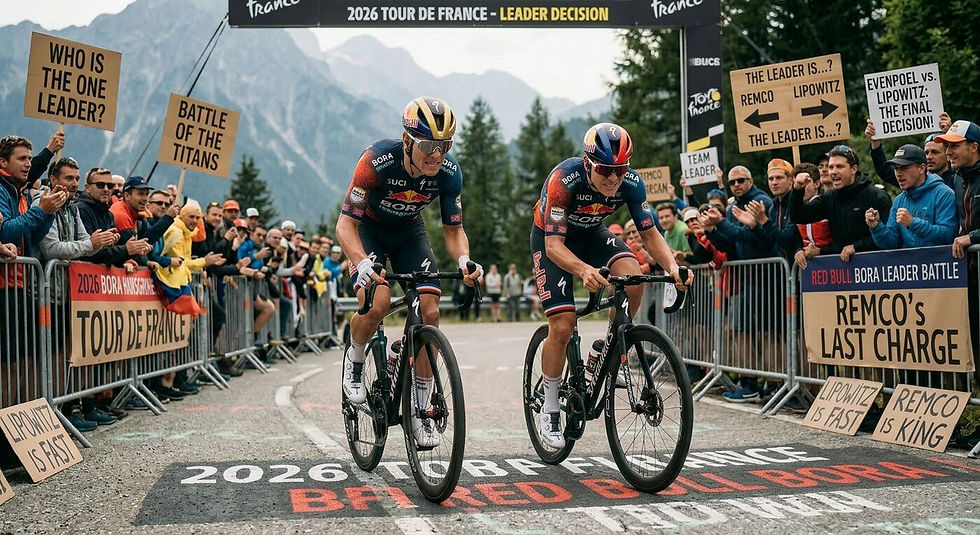
A joint-leadership Tour de France project is always a high-wire act. When Red Bull–Bora–Hansgrohe tout Remco Evenepoel and Florian Lipowitz as co-leaders, they’re stepping into a long, complicated tradition: two riders with one dream, one race, and only one yellow jersey. The model can work brilliantly — or implode spectacularly.
Two Leaders, One Maillot Jaune
The essential tension is simple: a Tour team can support two leaders, but the Tour itself only crowns one.
Red Bull’s 2026 plan — Evenepoel and Lipowitz as co-leaders — mirrors the most famous dual-leadership experiment in history: Hinault–LeMond in 1985 and 1986. That partnership produced two Tour victories, but also bitterness, suspicion, and a near-civil war inside La Vie Claire.
More recently we had Team Sky when Bradley Wiggins was leading but Chris Froome was flying. Wiggins felt very threatened by Froome’s aggressive style and my compatriot Dan Jones happened to be in the room next door one night when Wiggins unloaded on team boss Dave Brailsford. It got sorted but the relationship between Wiggins and Froome was severely damaged.
Modern teams try to avoid that chaos, but the underlying physics haven’t changed.

THE REVEAL
Team manager Ralph Denk has now spelled out the rules in the Flemish press, and they are not exactly reassuring. Evenepoel, he confirmed, is still the team leader, with Lipowitz “a bit of the second man” — but on form, he insists, the two are on equal footing. And then the line that lit the fuse: when one of them is stronger, Denk said, they will fight it out between themselves on the road.
“For a team boss to say that creates the wrong dynamic. I’m pretty sure that’s not what he’s saying internally.”
— John Trevorrow
Denk has reached for Formula 1 to explain it — the McLaren “Papaya Rules,” where two drivers race freely but never at the team’s expense. It’s a tidy comparison. It’s also a reminder that even in a sport with telemetry, radios and a pit wall, those rules get tested the moment one car is quicker than the other.
WHERE IT HAS FLIPPED BEFORE
Before the 2020 Tour de France, UAE Team Emirates lined up with Fabio Aru and a 21-year-old Tadej Pogačar as co-leaders — the experienced Italian the senior name on paper, the Slovenian the wildcard.
The hierarchy didn’t survive contact with the road.
Pogačar quickly proved the stronger rider and became the team’s outright GC leader, going on to win the whole thing. Aru’s race, meanwhile, unravelled: he struggled in the mountains and abandoned during Stage 9, dropped on his own inside the opening 20 kilometres.
The lesson Red Bull will know better than anyone: you can name your number one in June, but July does the deciding.

The 2026 Project
So what are Red Bull actually bringing to Barcelona?
On paper, one of the deepest squads in the race — and a deliberate one. The eight announced on 26 June are built almost entirely around the two GC leaders: Evenepoel and Lipowitz, backed by former Giro winner Jai Hindley, the in-form Maxim Van Gils, and a hard-riding engine room of Mattia Cattaneo, road captain Jan Tratnik, Nico Denz and Tim van Dijke.
The statement of intent is in who missed out: sprinter Jordi Meeus — a past Champs-Élysées stage winner — and his lead-out man Danny van Poppel were both left at home. This is a team chasing the podium, not stage scraps.
The two leaders arrive carrying the same line on the CV and very different momentum. Both finished third on their Tour debut — Evenepoel in 2024, when he also took the white jersey; Lipowitz in 2025, when he took white too. But Evenepoel comes in under enormous pressure after his blockbuster winter switch from Soudal–QuickStep, an injury-hit 2025 that ended in abandonment, and an unusual two-month racing blackout, betting everything on altitude.
Lipowitz, by contrast, just keeps delivering: podiums at Romandie, the Basque Country and Catalunya, then two stage wins and the overall at the Tour of Slovenia the very week the squad was confirmed. On current form, the “second man” has been the more reliable bet.

A ROUTE MADE FOR TWO CARDS
The 113th Tour suits this gamble more than most. It rolls out of Barcelona on 4 July — the third Spanish Grand Départ, after San Sebastián in 1992 and Bilbao in 2023 — with a 19.7km team time trial, the first opening TTT since 1971, run under the new format where each rider’s own time counts at the line rather than the fourth’s. From there it is relentless: 3,333 kilometres, a colossal 54,450 metres of climbing, eight mountain stages and five summit finishes, with the Pyrenees and the Tourmalet arriving inside the first week.
Crucially for Red Bull, there is just one individual time trial — 26.1km along the shore of Lake Geneva at the start of week three — and it lands tailor-made for Evenepoel against the clock. Then the race crescendos with back-to-back summit finishes at Alpe d’Huez on Stages 19 and 20, the first consecutive Alpe finishes in Tour history, before a Montmartre-laced finale in Paris. With that much climbing and so little time-trialling, a team that can still have two riders standing in the final week is either holding a royal flush or splitting its hand in two. That is the whole bet.
“The Tour is no longer won by an exceptional rider alone, but by an exceptional team.”
— Zak Dempster, Red Bull Chief of Sports
THE ELEPHANT IN BARCELONA
Of course, all of this assumes the race is for second place behind one man. Tadej Pogačar starts as the overwhelming favourite, chasing a fifth title after winning the Tour de Suisse in his build-up — and Denk himself conceded that if the Slovenian’s race goes to plan, it will be “damn difficult to challenge him at all.” Jonas Vingegaard and Visma lead the resistance, with a clutch of younger threats behind.
One notable absentee: Wout van Aert, ruled out after a training crash. If Evenepoel or Lipowitz does break through, the prize is historic — no Belgian has won the Tour since Lucien Van Impe in 1976, and Jan Ullrich, who won in 1997 remains the only German.


The Man Who Has Seen This Before
If anyone inside the Red Bull bus knows how a co-leadership really plays out, it’s the new strategic advisor. Allan Peiper was the sports director at UAE in 2020 — the very year a young Pogačar rode out of Aru’s shadow and into yellow — and after stepping away to beat cancer, he joined Red Bull–Bora–Hansgrohe ahead of this season. So I asked him about the challenge of joint leadership.
“Well, that’s up to team management — but they are two very different characters, and it should work.”
— Allan Peiper, to John Trevorrow
“Two very different characters” is the optimist’s case, and it’s a fair one: Evenepoel the natural-born, outspoken leader; Lipowitz the quiet metronome who simply turns up. Denk is convinced it can work.
Peiper, who has lived this exact film once already, thinks it should. And history says it can — La Vie Claire, Sky and UAE all reached Paris with a winner. Not one of them reached it with the peace fully intact. That’s the high-wire act. We’ll find out in July whether Red Bull can be the team that finally walks all the way across.
TWO RED BULLS — FOR NOW
Two leaders, one yellow jersey, and three weeks to settle it on the road.
Sources & further reading
Ralph Denk’s leadership remarks — Cyclingnews
Red Bull squad & dual-leadership announcement — Cyclingnews / Cycling Weekly
Allan Peiper joins Red Bull as strategic advisor — Cyclingnews
Fabio Aru’s 2020 Stage 9 abandon — Cyclingnews
2026 Tour de France route — overview


Comments