
The Giro always finds a way to create tension before the race even begins. This year it has done it again, but not in the way anyone expected. There is no Pogacar. There is no two titan showdown. There is only Jonas Vingegaard sitting at $1.17 with bookmakers and carrying the weight of being the clearest Giro favourite in years. The sporting narrative feels almost predetermined, which is why the real drama has shifted off the road and into the place where the Giro will actually begin.
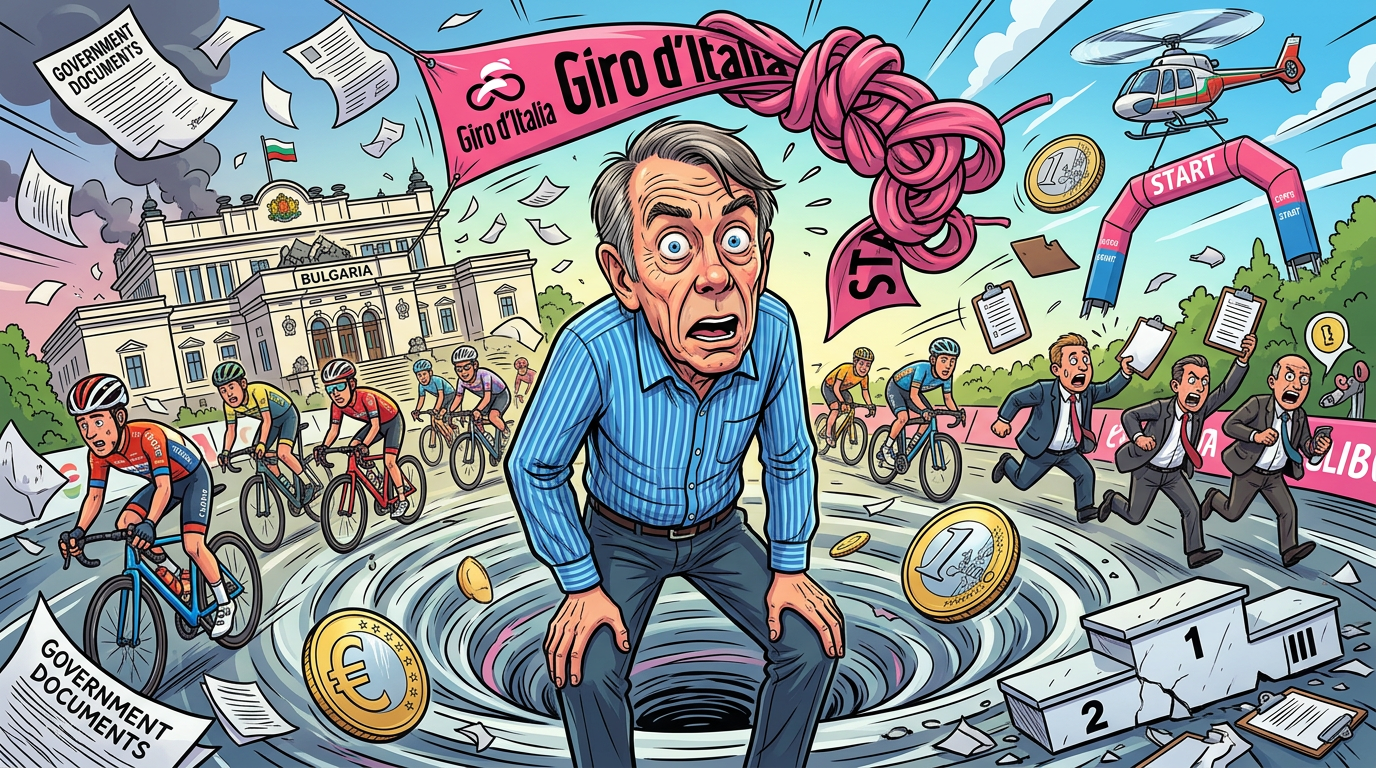
The conversation in cycling circles is no longer about who will take the first pink jersey. It is about whether Bulgaria can deliver the Grande Partenza it promised. It is about a government collapse, a financial standoff with teams, and a federation that is struggling to hold itself together. It is about the most fragile Giro opening since Israel in 2018, and the sense that the race is walking into a country that is trying to present its best face while its institutions are under pressure.
Everyone is talking about the problems. So here is the Detour deep dive into what is really happening.

A Government Collapse At The Worst Possible Time
The first and most serious issue is political. Bulgaria’s government fell only months before the Giro is due to arrive. The collapse was driven by protests, budget disputes and corruption allegations, and it has created a vacuum at the exact moment the country is supposed to be delivering a world class sporting event.
Foreign starts rely on government guarantees. They rely on ministries that can release funds, coordinate police, manage transport, secure venues and deliver the infrastructure that makes a Grand Tour possible. When the government falls, the guarantee becomes a question mark. When the guarantee becomes a question mark, everyone downstream begins to worry.
RCS has already taken the hosting fee. The new government must now honour it. That is the tension.
A Financial Standoff Between Teams And RCS
The second issue is the one that has the peloton talking. Teams are in a dispute with RCS over participation fees. This is unusual because foreign starts normally over deliver financially. They are meant to feel like a reward, not a burden.
Here is the reality.
What teams normally receive
Teams do not pay to race the Giro. They are paid to show up. Foreign starts usually include:
- Appearance fees in the low six figures
- Charter flights
- Freight support
- Accommodation upgrades
- Local transport
- Sponsor activation opportunities
The usual range is €100,000 to €200,000 per team for a foreign start. It is designed to cover the extra cost of long transfers, staff relocation, equipment movement and lost training days.
What RCS offered for 2026
- €115,000 per team plus €5,000 in airline vouchers
- Then €125,000 per team
Both offers were rejected.
What teams want
- €160,000 per team, which totals €3.68 million across the WorldTour field.
Teams argue that the transfer from Bulgaria back to Italy is long, expensive and disruptive, and that the offer from RCS does not reflect the scale of the logistical burden.
Why this matters
Teams know RCS is receiving €12.5 million from Bulgaria. They believe the organiser is protecting its margin at their expense. One team official described the offer as “showing us no respect at all.”
If no agreement is reached, the dispute may go to the Professional Cycling Council. That is rare. That is serious.

A Cycling Federation In Turmoil
The third issue is organisational. The Bulgarian Cycling Federation is described as unstable and internally divided. This matters because the federation is a key operational partner for RCS. A weak federation increases the risk of:
- volunteer shortages
- inconsistent local coordination
- delays in route preparation
- gaps in safety planning
- communication breakdowns between local and international staff
Bulgaria has never hosted a race above UCI .2 level. The biggest global event it has staged in the last decade was the 2018 Volleyball World Championships. This is a massive leap in scale and complexity.
When the federation is shaky, the foundation of the event becomes shaky.

The Giro Still Rolls On
Despite the noise, the Giro almost never walks away once money has changed hands. RCS has already accepted the €12.5 million hosting fee. Bulgarian officials continue to publicly support the event. Local organisers insist preparations are “positive” despite earlier doubts.
The Giro has survived worse.
- Israel 2018 survived geopolitical tension.
- Belfast 2014 survived cross border complexity.
- Budapest 2020 survived a pandemic delay.
The Giro is a machine. Once it is moving, it rarely stops.

What This Means For The Giro?
This start is no longer a simple tourism showcase. It is a stress test. It is a country trying to present itself to the world while its political system is unstable, its federation is under pressure and its financial commitments are being questioned by the very teams that make the race possible.
It is also a reminder that the Grande Partenza has become one of the most high stakes events in world sport. It is not just a ceremonial roll out. It is a negotiation between governments, organisers, teams, broadcasters and sponsors. When one part of that structure wobbles, the entire event begins to shake.
And that is why the Bulgaria start is now one of the most fascinating openings the Giro has attempted in years. If it succeeds, it becomes a story of resilience and reinvention. If it stumbles, it becomes a warning about the risks of chasing new markets without the institutional strength to support them.
Either way, it will not be boring.