
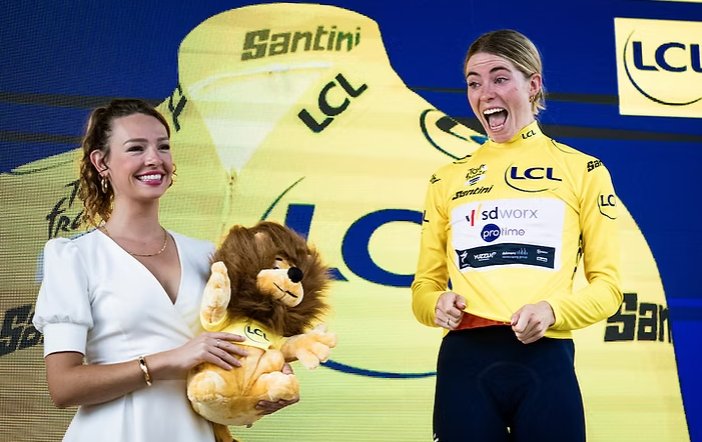
There are seasons when one rider seems to be everywhere, and seasons when that rider takes ownership of the sport. The 2026 Women’s WorldTour was the second kind.
From the cobbles of Flanders to the Angliru, the Italian Alps and the climbs above Nice, women’s cycling gave us a year of extraordinary racing, new names and established champions. And at the centre of it all was Demi Vollering.
She didn’t just win races in 2026. She conquered them: the Classics, two Grand Tours, the World Championships and the European title. But there was plenty happening behind her. Her rivalry with Kasia Niewiadoma-Phinney gave the sport its edge, Paula Blasi announced herself as a stage racer, Lorena Wiebes kept the sprinters honest, and some familiar names reminded us that experience still counts for plenty.
The spring Classics
Vollering opened her account at Omloop Het Nieuwsblad, getting clear with Niewiadoma-Phinney over the Muur van Geraardsbergen and taking the win in Ninove.
March belonged to a broader cast. Elise Chabbey won Strade Bianche, the biggest win of her career, after the race splintered across the Tuscan gravel. Lotte Kopecky took Milano-Sanremo Donne, attacking over the Cipressa and Poggio and then finishing it off with her speed. Wiebes won Gent-Wevelgem again, and Karlijn Swinkels took the Trofeo Alfredo Binda.
The cobbles
April was when Vollering really went to work. Her first Tour of Flanders was a milestone. She used the strength of her FDJ United-SUEZ team, made her move on the Oude Kwaremont, and once she was clear, nobody was catching her.
Paris-Roubaix was a different story, and one of the best of the season. Franziska Koch reached the velodrome in a select group with Marianne Vos and Pauline Ferrand-Prévot, then beat Vos in the sprint. Beating Vos at Roubaix is no small thing, and it puts Koch firmly among the elite Classics riders. Full marks to Vos for being there again, too. Class never goes out of fashion.
The Ardennes
Then it was back to Vollering. She won Flèche Wallonne on the Mur de Huy, then rode away after La Redoute to win Liège-Bastogne-Liège.
In between, young Spaniard Paula Blasi attacked from distance to win the Amstel Gold Race, ahead of Niewiadoma-Phinney and Vollering. People were starting to sit up and take notice, and we’d hear a lot more from her before the year was out.
By the end of April, Vollering had four of the spring’s biggest races to her name. That’s an extraordinary Classics campaign by any measure.
La Vuelta Femenina: Blasi arrives
The women’s Grand Tours keep growing in stature, and 2026 gave us three very different races. The first delivered a real surprise.
Anna van der Breggen, back among the very best, went into the final stage on the Angliru with an 18-second lead over Blasi. The mountain turned the race upside down. Blasi cracked her on the steepest slopes, finished second on the stage and won the Vuelta by 24 seconds.
For Van der Breggen it was a bitter pill after doing so much right. For Blasi, it was proof that a new generation is knocking loudly on the door.
Giro d’Italia Women: the battle for pink
If the Vuelta was a surprise, the Giro was a heavyweight contest. Van der Breggen took the maglia rosa with a brilliant time trial, and Vollering fought back with wins in the mountains but couldn’t prise the jersey off her. Germany’s Antonia Niedermaier stayed in the fight all the way through.
It came down to the final day around Saluzzo. Vollering made the decisive move in the closing kilometres, overturned the deficit and won the Giro. Niedermaier finished second and Van der Breggen dropped to third, losing a Grand Tour on the last day for the second time in a month. Elisa Longo Borghini won the stage.
And here’s the bit that matters for the history books: the Giro made Vollering only the second woman to win all three Grand Tours.
Tour de France Femmes: yellow for Demi
The Tour was always going to be a highlight, and it didn’t disappoint. Wiebes made her presence felt early with sprint wins, Marlen Reusser had a spell in yellow, and then Niewiadoma-Phinney won on Mont Ventoux to take the lead.
But everyone knew Vollering wasn’t finished. She won the penultimate stage into Nice to take yellow by eight seconds. On the final day she attacked on the last climb of the Col d’Èze, rode away to win the stage, and sealed the Tour by 1 minute 18 seconds from Niewiadoma-Phinney, with Longo Borghini third.
It was her second Tour de France Femmes and, after the Giro, a Giro–Tour double. For Niewiadoma-Phinney, another second place was a tough one to swallow.
Montréal: the rainbow jersey
The World Championships in Montréal put the finishing touch on it. After years of near misses, Vollering finally won the elite road race, beating Niewiadoma-Phinney in a two-up sprint, with Longo Borghini taking bronze.
Reusser defended her time trial title, with Zoe Bäckstedt taking silver. A week later, Vollering won the European road title in Slovenia, her first race in the rainbow jersey.
The other big stories
It would be unfair to make the year all about Vollering.
Lorena Wiebes was the most prolific winner in the peloton, with 24 road wins. Her speed and consistency made her the sprinter everyone wanted to beat.
Marlen Reusser was outstanding against the clock: the Tour de Suisse and a second straight world time trial title.
Elisa Longo Borghini showed again why she’s one of the most respected riders in the sport, with the UAE Tour, third at the Tour de France and bronze at the Worlds.
And Kasia Niewiadoma-Phinney deserves a special mention: second at Omloop, Strade Bianche, Amstel, the Tour and the Worlds. Cycling can be a cruel business, but her consistency was remarkable.
Then there are the new names. Blasi, Koch, Chabbey and Bäckstedt all gave us reasons to be excited about what’s coming.
The final word
Look back at 2026 and it’s hard not to be impressed by how far women’s professional cycling has come. The racing is deeper, the competition is stronger, and the big events are getting the attention they deserve. The Classics have their own personalities, the Grand Tours are delivering real drama, and the next generation is starting to challenge the established order.
As for Demi Vollering: sixteen wins, including Omloop, Flanders, Flèche, Liège, the Giro, the Tour, the Worlds and the Europeans. That is some season, and a big step towards the very top of the sport’s history.
The question for 2027 is whether anyone can stop her. Women’s cycling is in a terrific place, and I reckon we’re in for another fascinating year.


