
Women’s Cycling Isn’t Rising - It’s Erupting
- John Trevorrow

- May 2
- 3 min read

Let’s be honest: women’s cycling doesn’t need a report card. It doesn’t need a polite pat on the back or a tidy list of who impressed and who fell short. What it really needs is a megaphone big enough to match the scale of what has happened in the past five years. Because this isn’t steady progress. It’s a full‑blown eruption.

The Visibility Boom That Changed Everything
Not long ago, following women’s cycling meant scavenging for scraps. You crossed your fingers for a livestream, refreshed Twitter for updates, and hoped someone, somewhere, had a camera pointed at the race. In 2018, only 12 percent of Women’s WorldTour events were broadcast live. That wasn’t a lack of interest. It was a lack of access.
By 2024, that number had rocketed to 87 percent. That isn’t growth. That’s a revolution.
The relaunch of the Tour de France Femmes in 2022 lit the fuse. Broadcast in 190 countries and generating more than 23 million social interactions, it instantly became the global centrepiece the sport had been denied for decades. Suddenly, women’s cycling wasn’t something you stumbled across. It was something you planned your day around.
Visibility creates heroes. It creates storylines. It creates momentum. And for the first time, women’s cycling has all three in abundance.

Money Meets Momentum
Once the cameras arrived, the brands followed, and they didn’t tiptoe in.
Fans of women’s sport are significantly more likely to recognise sponsors and buy from them, making this audience one of the most commercially valuable in global sport. Combine that with sponsorship costs that remain lower than the men’s peloton and you get a rare commercial sweet spot: high impact with a comparatively low barrier to entry.
Team budgets tell the story. Women’s WorldTour squads now average €4.67 million, fuelling better support structures, deeper staffing, improved equipment, and a level of professionalism that is accelerating at warp speed.
But rapid growth brings pressure. Costs have risen close to 30 percent in recent years, and just like on the men’s side, smaller teams in certain regions are struggling to keep pace. The top end is booming, but the development layers need stability to ensure the whole pyramid rises together.

A Calendar With True Icons
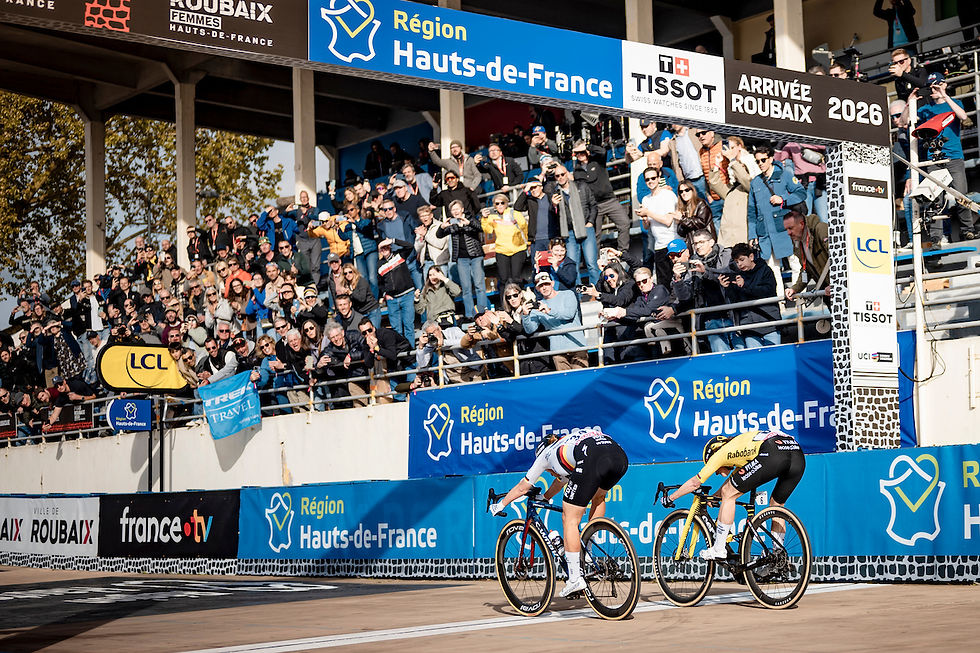
For decades, women’s cycling lacked the marquee events that define a season. No Roubaix. No Tour. No true Monuments. The sport had brilliance but not the pillars that give a calendar its shape.
That era is over.
Today, women’s cycling has a full suite of iconic races, and they are spectacular:
Santos Tour Down Under — the season‑opening statement that sets the tone
Cadel Evans Great Ocean Road Race — a modern classic with a distinctly Australian flavour
Strade Bianche Donne — white roads, chaos, brilliance
Milan–Sanremo Donne — the long‑awaited Spring epic
Ronde van Vlaanderen — cobbles, climbs, pure theatre
Amstel Gold Race — punchy, unpredictable, unmistakable
La Flèche Wallonne — the Mur de Huy proving ground
Liège–Bastogne–Liège Femmes — a true Ardennes Monument
Paris–Roubaix Femmes — instantly legendary from its first edition
La Vuelta Femenina — a Grand Tour‑level anchor in Spain
Tour de France Femmes — the cultural moment, the global centrepiece, the race that changed everything
These aren’t token additions. They are the backbone of a modern, world‑class calendar, and they have finally given the sport the narrative structure it always deserved.
A Global Cycling Boom Feeding the Fire
The rise of women’s pro cycling mirrors a broader global trend: more people are riding bikes than ever. The global bicycle market is projected to reach more than $127 billion by 2026, and as recreational participation surges, interest in elite racing grows with it.
The Tour de France Femmes securing its own standalone broadcast slot was the industry’s loudest statement yet. This isn’t a companion product. It’s a main event.
The Only Real Question: How Big Can This Get?
Women’s cycling is no longer niche. It’s no longer secondary. It’s no longer something you have to justify caring about. It is globally visible, commercially powerful, athletically world‑class, and growing faster than men’s cycling across key metrics.
The next frontier is sustainability, ensuring the sport’s rapid rise doesn’t leave development teams behind and that investment reaches every layer of the pyramid.
But right now, the sport is flying. And the most exciting part is that it still feels like the beginning.
Women’s cycling doesn’t need one of my Detour Report Cards. It needs a headline:
This is the fastest‑growing, most electric movement in world cycling, and the next five years will make today look like the warm‑up.


Comments