
The Rise, the Disappearance, and the Return of Freddy Maertens
- John Trevorrow

- 3 days ago
- 5 min read

Ever since Dan put out that Top Ten Comebacks story, people have been asking me whether I gave him a proper serve for leaving out Freddy Maertens. I can confirm that I did. I told him that leaving Freddy out of a comeback list is the cycling equivalent of forgetting to mention the Great Ocean Road when someone asks about the best drives in Australia. It is not a small oversight. It is a howler. And I say that with affection, because Dan knows I love him, but he also knows that when it comes to cycling history, I do not let things slide.
Freddy was not just a great rider. He was a force of nature. I saw him as a young man, I saw him at his absolute peak, I saw him when he fell off the map, and I saw him rise again in a way that still feels impossible. If you want a comeback story, you start with Freddy. You do not leave him out and hope no one notices.

Munich 1972 and the First Glimpse of a Phenomenon
My first race against Freddy was at the Munich Olympics. I was twenty two and he was twenty, and even then he had that unmistakable Belgian sprinter’s build. He looked like someone who had been raised on cobbles and crosswinds and had never once considered the idea of taking it easy. He was already a star in the making.
When you look back at the results from that race, the field reads like a who’s who of the era. Clyde Sefton, my Australian teammate, took the silver medal, which remains the only Olympic road race medal won by an Australian male. Hennie Kuiper won the gold and Kiwi Bruce Biddle eventually received the bronze after the Spaniard who crossed the line third was disqualified for a positive test. Phil Bayton and Phil Edwards from Britain were fifth and sixth. Francesco Moser was eighth. I finished thirty second behind the great Polish amateur Ryszard Szurkowski, who was one of my heroes at the time.
Down in sixty first place was John Howard. Not the Australian Prime Minister, but the American who later won the first Hawaiian Ironman. It was a remarkable field and Freddy was already right in the thick of it.
Barcelona 1973 and the World Title That Should Have Been His
The following year in Barcelona, Freddy produced a ride that should have made him world champion. He finished second to Felice Gimondi in a sprint that has been argued about for half a century. Many people who were there still insist that Freddy was the rightful winner. It was the first major sign that he was not just talented but destined for greatness. He had the speed, the strength, and the race sense that only the very best possess.

The Explosion of 1976 and 1977
Then came the period that still defies belief. Between the middle of 1976 and the middle of 1977, Freddy produced one of the most dominant twelve month stretches in the history of the sport. He won twenty eight Grand Tour stages in less than a calendar year. He took eight stages at the Tour de France, thirteen at the Vuelta a España, and seven at the Giro d’Italia. He won fifty four races in 1976 alone. He won the green jersey at the Tour. He won the world title in Ostuni. He won the Vuelta from start to finish in 1977 and took thirteen stages along the way, a record that still stands.

I raced him in Belgium just before the 1976 World Championships and I can tell you that I have never seen anything like it. Freddy attacked from the start and the pace was so ferocious that it felt like motor pacing. After only a couple of kilometres I looked back and there was nothing behind us. No peloton. No chase. Just ten of us hanging on for dear life, including his Flandria teammates Michel Pollentier and Marc De Meyer.
He was riding with such power that when I punctured with about fifteen kilometres to go, I had time to change the tyre and still roll in for tenth place. That is how fast we were going. He was the overwhelming favourite for the world title in Ostuni and he delivered, beating Moser in a two man sprint. Don Allan from Australia finished ninth, which was a terrific ride.

The Missing Years and the Sudden Collapse
Then came the years that people still talk about in hushed tones. After winning the green jersey at the 1978 Tour, Freddy’s form collapsed. He went from being compared to Eddy Merckx to struggling to finish races. He did not win anything of significance for two seasons. Belgium being Belgium, the rumours started immediately. Some said he had injured himself pushing enormous gears. Others whispered about alcohol. Others blamed doping. There were stories about financial disaster, lost money, bad advice, and tax problems that nearly ruined him.
The truth is probably a mixture of all of it. What matters is that he went from being the most dominant rider in the world to being written off entirely. People said he was finished. People said he would never win again. People said the Freddy they knew was gone forever.
The Resurrection of 1981
And then he came back. Not quietly. Not gradually. He came back with a roar. In 1981 he won five stages of the Tour de France and took the green jersey again. He arrived at the World Championships in Prague with the kind of form that only he could produce. It was one of the greatest sporting resurrections I have ever seen. And yes, Dan, it absolutely belonged in your comeback list.
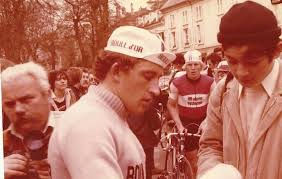
Prague and My Small Part in His Second Rainbow
I had seen Freddy earlier that year at the Tour of Germany. The Belgian team had lost faith in him after his crash ridden seasons, but he had just won five stages at the Tour and the green jersey. He came up to me and asked if I would help him at the Worlds. I had been sick and knew I would not finish the race, so I agreed.
Wayne Hildred, a Kiwi who had become an adopted Aussie, was Freddy’s teammate at Boule d’Or and the team paid his way to support him. The day before the race, Wayne rode the finishing climb with Freddy and came back shaking his head. Freddy had ridden the hill in a fifty three thirteen and looked like he was floating. Wayne said the team manager had announced at dinner that Freddy would win. It was not a prediction. It was a statement.
On race day my job was simple. Stay near Freddy and help when needed. When he jumped across to the leaders, I knew the race was over. He won his second world title with the authority of a man who had come back from the dead.
At the airport he thanked me and said we would settle up at the next race. Then he got invited to a bigger one in Spain and I never saw the money. When I saw him at the Tour Grand Depart in Brussels in 2019, we had a good laugh about it. Still no cash.

And Dan, Let This Be a Lesson
Next time you put together a list of great comebacks, run it past me before you publish it. Because if Freddy Maertens is not in there, you can be sure I will be on your case. Some riders are good. Some riders are great. And some riders come back from the dead and win the world title. Freddy belongs in that last group.


Comments