
Cycling’s Biggest Marginal Gain Is Mindset
- Dan Jones

- May 7
- 7 min read
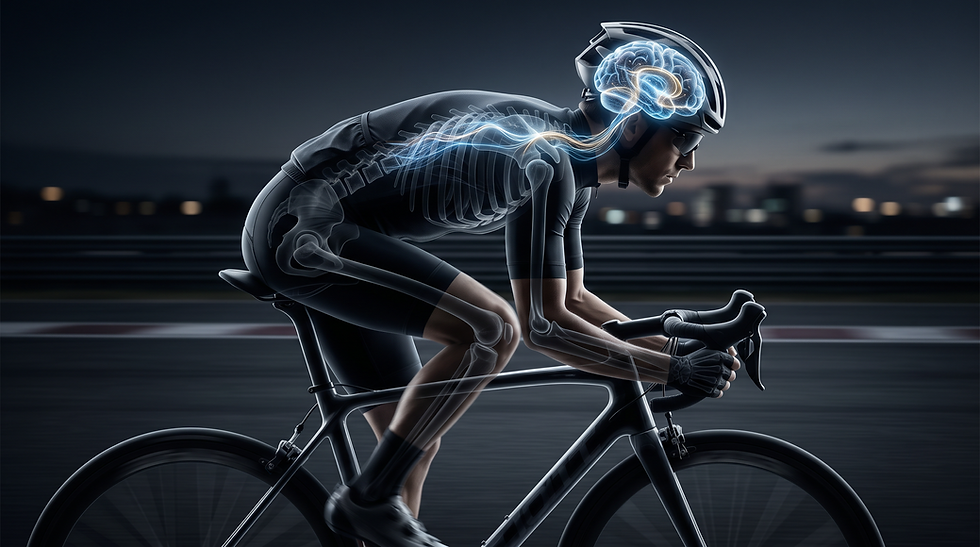
Champions do not just have big engines. They have regulated nervous systems
One of the most fascinating things I have learned from years inside elite sport is that the athletes who look the calmest on the outside are usually the ones doing the most sophisticated work on the inside. And the science backs it up. Studies across multiple sports show that athletes with better emotional regulation and lower chronic stress markers recover faster, get injured less, and perform more consistently under pressure.
Some research even suggests that unmanaged psychological stress can increase injury risk by up to fifty percent, and that athletes with high stress loads take significantly longer to return to peak performance after setbacks.
When you look at the very top tier of cycling, the Pogacars and the Seixases, the riders who seem to float through chaos like they are riding inside their own weather system, you can see this play out in real time. They do not get rattled easily. They do not burn emotional energy on things they cannot control. They do not let the moment hijack their nervous system. And that, more than any wattage number or lab test, might be the real separator.
Because mindset is not a vibe. It is physiology. It is chemistry. It is the difference between a body that interprets pressure as a threat and one that interprets it as information.

The Pogacar effect. Calm as a superpower
I have seen this up close. When Matt Keenan and I were making a documentary on Allan Peiper, he told us the moment he realised Tadej Pogacar was not just talented. He was different. Pog was still a kid, racing in Australia, when he lost his passport. For most riders that would trigger a full blown meltdown because passports mean visas and visas mean races and races mean contracts and suddenly the whole season feels like it is hanging by a thread.
But Pog did not panic. He did not spiral. He did not start imagining worst case scenarios. He stayed relaxed, almost amused by the whole thing.
Allan said that was the moment he knew. Not because losing a passport is a big deal, but because Pog’s reaction revealed a nervous system that does not flip into fight or flight at the first sign of trouble. That is not just personality. That is emotional regulation. That is resilience. That is the kind of internal stability that wins you Grand Tours. So Allan back in 2020 went all chips in on this 21 year old kid.
And when you watch him race, you see the same thing. He does not panic when he is isolated. He does not overreact when he is attacked. He does not waste energy on fear. He stays present, playful, curious. All signs of a brain operating in a regulated state, not a threatened one.

Paul Seixas and the new generation of mentally fluent athletes
When Plumber Dunc brought in Max Goold the podcast and he told us, without blinking, that his goal was to one day win the Tour de France and ride at the Brisbane 2032 Olympics, I remember thinking how refreshing it was to hear a young athlete say something like that without apology. The older brigade often hears a statement like that and immediately translates it as arrogance, but the reality is the complete opposite. It is clarity. It is ambition without fear. It is a young athlete who has not yet been conditioned to shrink their dreams to make other people comfortable.
You see the same thing in Paul Seixas. Listen to the way he speaks after races. Watch the videos of him telling his family he is riding the Tour de France. There is no weight of expectation crushing him, no sense that he is carrying the hopes of an entire nation on his shoulders. If it were most of us, we would be thinking, far out, if I ride the Tour I am carrying the emotional burden of the French nation and half of Europe. But Paul is not wired that way. There is a youthful excitement to him, a confidence that is not performative, a belief that does not need to be defended or justified. It is simply there.
And that is the point. This new generation is not scared of big goals. They are not scared of saying them out loud. They are not scared of dreaming in public. They do not carry emotional baggage from one moment to the next. They bounce back faster than the situation should allow. They process disappointment without letting it poison the next race.
There is a lightness to them, a sense that they understand something older athletes often learn too late, which is that mindset is not about pretending to be tough. It is about staying open, staying curious, staying regulated when the world around you is trying to pull you apart.
That is not softness. That is skill. And it is becoming one of the most valuable skills in elite sport.

The science. Stress is a performance variable, not a character flaw
For years sports science has been mapping the relationship between psychological stress and physical performance, and the more the research piles up, the more brutal the picture becomes. A 2024 paper in Frontiers in Psychology looked at stress in sport through what they call a psycho neuro endocrine immune lens, which is a fancy way of saying your thoughts, hormones, immune system and nervous system are all in the same group chat, and stress is the loud one that never stops talking. When distress is high, it does not just make you feel anxious. It changes how your body works. It pushes cortisol up, messes with your ability to focus, narrows your attention, and drags down self confidence, all of which are poison in a race situation.
Then you add sleep into the mix. A 2023 review on professional athletes pulled together 38 studies and basically confirmed what every tired rider already knows in their bones. Poor sleep does not just make you a bit grumpy. It hits training quality, slows recovery, increases injury risk, and chips away at mental health. Sleep is not a nice to have. It is one of the main levers that decides whether your body can actually adapt to the work you are throwing at it or whether you are just digging a deeper hole.
Put simply, chronic stress elevates cortisol, disrupts sleep, slows tissue repair, impairs decision making, and increases the likelihood of both soft tissue injuries and illness. It also reduces motor coordination and reaction time, which in a sport where millimetres matter is basically a performance tax you are paying every single day without realising it.
This is where the idea of allostatic load comes in. Allostatic load is just a technical term for the cumulative wear and tear on the body from repeated stress. Training load is one part of it, but so are money worries, family issues, media pressure, contract uncertainty, travel, social media noise, and everything else that lives rent free in an athlete’s head. The higher the allostatic load, the harder it is for the body to adapt. Athletes with high allostatic load plateau sooner, burn out faster, get sick more often, and struggle to maintain consistency across a long season.
This is why sports like the AFL have moved to embed full time psychologists inside clubs. It is not because it looks good in a brochure. It is because the data and the lived experience both say the same thing. Injury rehab is emotional. Pressure is emotional. Identity is emotional. If you ignore that, you are not just being old school. You are leaving performance on the table.

The final example that says it all
I want to finish with one story from outside cycling because it captures everything this article has been about. It is the story of Luka Doncic, a basketball player most cycling fans would barely know. Think of him as the Vingegaard of the NBA. Quiet. Brilliant. Generational. The kind of athlete who normally looks untouchable.
Yet this past year his body has kept breaking down. A calf strain. A grade 2 hamstring tear. Same leg. Same pattern. And for months everyone blamed conditioning or workload. Then the truth came out. The trade he never saw coming. His partner moving home with their daughter. The police being called during the birth of his second child. A custody battle across two continents. A decade long relationship ending in public. And through all of it he was carrying one of the biggest teams in world sport.
Two weeks after the custody headlines peaked, his hamstring tore again.
That is not coincidence. That is what life stress does to a body, even a world class one. It changes how you move. How you heal. How you react. How you stay whole. It is the same lesson cycling is finally waking up to. The nervous system does not care how fit you are. It cares how safe you feel.
And that is why mindset is not a soft skill. It is the biggest marginal gain left in the sport.
The calm ones win. The regulated ones last. The ones who can hold their centre when everything around them is shaking are the ones who rise.
The takeaway for the rest of us
And if you are not an athlete, here is the part that matters. Your body works the same way theirs does. Stress does not stay in your head. It shows up in your sleep, your patience, your immune system, your energy, your decision making, your ability to cope. The same way Luka’s hamstring tore under the weight of his life, the same way a rider loses form when their world is shaking, the rest of us break down in quieter ways. The lesson is simple. Your nervous system is the engine. If you look after it, everything else works better. If you ignore it, everything else eventually pays the price.


Comments