
THE PELOTON CODE IS DEAD — WELCOME TO THE NEW WILD WEST OF CYCLING
- Dan Jones

- Apr 20
- 7 min read

The old rules didn’t break. They were abandoned.
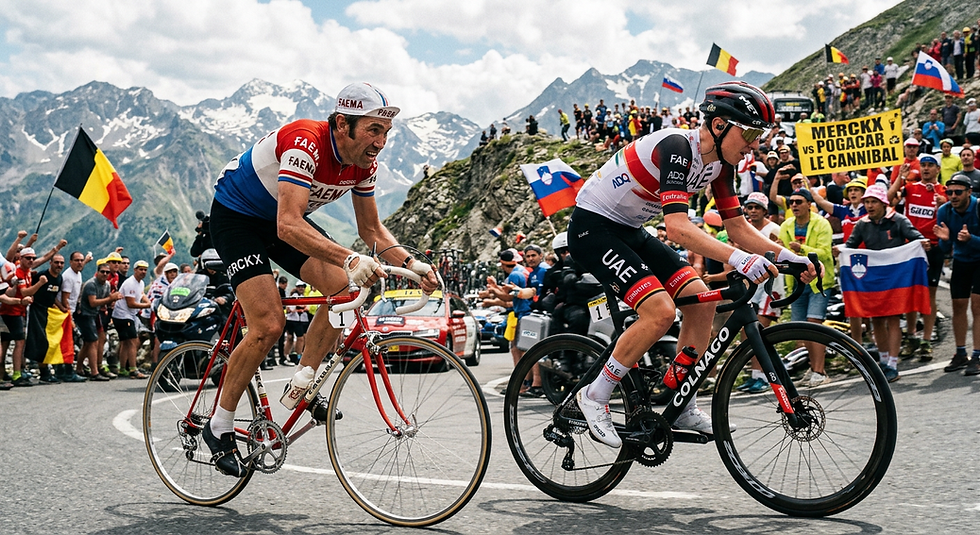
There was a time, not that long ago, when the peloton behaved like a travelling parliament, a rolling senate of hardmen who understood that the sport was brutal enough without adding unnecessary chaos, and if you wanted to survive three weeks of racing you needed a little order, a little hierarchy, a little respect for the unwritten code that kept everyone upright and vaguely sane. But that world has vanished, replaced by a generation that races like the sport owes them nothing and the only rule worth following is the one that gets you to the line first.
The veterans can feel it. The DSs can feel it. Anyone who’s watched the first hour of a modern race, where the peloton hits 55km/h before the TV broadcast even starts, can feel it. The sport has changed, and the old etiquette has been tossed out the window like an empty bidon on a mountain descent.

The new generation doesn’t wait, doesn’t yield, and doesn’t care about your hierarchy
Ask any rider who’s been around long enough to remember when the peloton had elders, and they’ll tell you the same thing: the kids don’t care. Damien Touzé said it bluntly after a crash that nearly ended his career: “Before, there was perhaps more respect in the peloton… now a lot of young riders arrive wanting to make their place, and they don’t care about the rules. The tension is constant. Everything goes faster. Too fast.”
It’s not bitterness. It’s not nostalgia. It’s simply the truth of a sport that has been rewired by youth, data, Zwift, and a points system that punishes patience. Riders used to spend years learning the rhythms of the bunch, understanding when to fight and when to breathe, when to hold your line and when to let someone in. Now they arrive at the WorldTour at twenty‑one with a VO2 max that looks like a typo and a mindset that says every metre is a battlefield.
Luke Durbridge, who’s seen more Tours than most people have had birthdays, summed it up with a shrug that carried a decade of bruises: “There’s not a hell of a lot of respect in the bunch anymore.” And when a rider like Durbo says that, you know the shift isn’t theoretical, it’s lived experience.

The peloton used to have sheriffs. Now it has algorithms.
There was a time when the bunch had enforcers, riders who didn’t need to shout or gesture because their presence alone kept the peace. Tom Boonen could calm a nervous peloton with a glance. Fabian Cancellara could slow a race simply by sitting up. Jens Voigt could end an argument before it started. And if you go back further, into the technicolour era of Mario Cipollini, the entire Giro d’Italia would bend to the will of one man in a silver skinsuit.
Cipo didn’t just control sprints, he controlled the day. If he wanted an easy stage, the peloton would roll along at a pace that made the commentators wonder if the time checks were broken. Hours of soft‑pedalling, a break allowed just enough rope to stay interesting but never enough to threaten the script, and then, when the great man decided the show should begin, the entire race snapped to life like someone had flicked a switch. It was theatre, it was ego, it was choreography, and it was absolutely understood: you didn’t mess with the Lion King’s stage.
Those days are gone. No one controls anything now. The peloton is a swarm, a living organism with no leader, no hierarchy, no patience. The break doesn’t get ten minutes anymore. Sometimes it doesn’t even get formed. The first hour is a fistfight, the middle hours are a fistfight, and the final hour is a fistfight with better camera angles.

The bodies have changed too — and Will Walker saw it coming
A few years back we sat down with Will Walker, and his story still hits like a punch to the ribs because it came from a time when the sport believed young bodies simply weren’t built for the brutality of Grand Tours. Will was thrown into the Vuelta at twenty, an age when most riders were still learning how to survive crosswinds, and the criticism was fierce because the consensus back then was clear: the human body needed years of conditioning before it could withstand three weeks of racing at the limit. Will’s own body paid the price, his heart pushed beyond what it could safely endure, and his career became a cautionary tale about the dangers of rushing talent.
But the sport has flipped that logic on its head. The very thing that once broke riders like Will is now the norm. The new generation doesn’t just survive Grand Tours at twenty‑one, they win them. Tadej Pogačar didn’t wait for his “mature years” to arrive; he walked into the Tour de France like it was a junior stage race and tore the script to shreds. Remco Evenepoel, Juan Ayuso, Carlos Rodríguez, they’re all rewriting the physiology textbooks in real time.

The idea that a rider needed to “grow into” the demands of a Grand Tour now feels like a relic from another century, a belief system that evaporated the moment the kids proved they could do the impossible.
The peloton hasn’t just changed in attitude. It has changed in biology, in preparation, in expectation. The bodies are different. The timelines are different. The sport is different.
Speed has replaced respect, and survival has replaced etiquette
Modern cycling is faster than anything the old guard ever imagined. Riders don’t train for endurance anymore — they train for repeated violence. Every climb is an interval. Every flat section is a drag race. Every corner is a gamble. And when you combine that with a generation raised on Zwift, where the concept of “waiting” doesn’t exist, you get a peloton that behaves like a swarm of caffeinated hornets.

Marc Madiot, never one to sugarcoat anything, described the modern peloton as “a war for points, a war for places, a war for positions.” There’s no room for courtesy in a war. No space for the old gentleman’s agreements. No time to honour the traditions that once kept the sport from eating itself alive.
The unwritten rules, don’t attack during a nature break, don’t dive bomb your own teammates, don’t sprint for 17th are now optional at best, forgotten at worst. And the riders who still believe in them are finding themselves outnumbered, out‑gunned, and occasionally out of contract.

The Young Gun the Old Mob Should Fear Most
Every Wild West tale has that one outlaw who rides into town and makes the whole saloon go quiet, the kind of kid who doesn’t just join the gang of young guns but threatens to take over the entire territory before anyone has even finished their morning coffee, and right now that rider is Paul Seixas. He is nineteen years old and already carries himself with the calm menace of someone who has never been told to wait his turn, never been warned about hierarchy, and never been taught the old etiquette that once governed the peloton like a dusty frontier lawbook. His second place at Strade Bianche was the moment the world noticed him, but it was not the moment he arrived. That had already happened long before, in the junior ranks where he won the time trial world title with the kind of precision that makes coaches whisper about destiny, and again when he claimed the Tour de l’Avenir, the race that has predicted more Grand Tour winners than any crystal ball ever could.
Seixas has been stacking markers like a kid piling poker chips in a backroom card game. He became the youngest rider in decades to crack the top ten at the Critérium du Dauphiné, a race that usually chews up teenagers and spits them out somewhere near the broom wagon. He won the Faun Ardèche Classic with the composure of a veteran who has spent years learning how to read a race, and then he went to the Basque Country and tore the place apart, winning the overall, the points, the mountains, and the youth classifications as if he had decided the entire week belonged to him. He has taken time trial stages, mountain stages, and rolling stages, and he has done it all with the same expressionless confidence that makes the old mob of the peloton shift uneasily in their saddles.

What makes Seixas so dangerous is not just the results, although they are already frightening enough for a rider who still looks like he should be signing autographs at junior races. It is the way he races, the way he moves through a bunch with the quiet certainty of someone who has never known fear, the way he treats every climb and every sector and every attack as an invitation rather than a threat. He is the French outlaw the peloton did not see coming, the kid who has rolled into the dusty main street of the WorldTour with a clean face, a steady gaze, and absolutely no intention of respecting the old code that once kept the peace.
If the peloton is a frontier town in the middle of a generational takeover, then Paul Seixas is the rider who walks through the swinging saloon doors and makes even the other young guns look over their shoulders. He is the biggest threat to the old mob because he does not just represent the new era. He embodies it. He is its sharp edge, its restless energy, its refusal to wait, and its belief that greatness is not something you grow into slowly but something you seize the moment you feel strong enough to reach for it.

The chaos is real, but so is the entertainment
Here’s the twist: for all the danger, for all the tension, for all the veterans shaking their heads at the madness of it all, the sport has never been more watchable. The new generation may have torched the old code, but they’ve replaced it with something undeniably electric. Races explode earlier. Breaks survive more often. GC battles start in March. And every stage feels like it could tilt the entire season.
It’s messy. It’s unpredictable. It’s occasionally terrifying. But it’s alive.
And maybe that’s the point. The old peloton was a monarchy. The new peloton is a democracy with no rules and no brakes. The old guard had order. The new guard has chaos. And somewhere in the middle of that tension, cycling has found a new identity — faster, younger, wilder, and utterly unwilling to coast along for three hours waiting for the script to begin.
The code is dead. The sport is not. And if you’re watching from the roadside or the couch or the team car, you can’t help but admit it: this new era might be insane, but it’s impossible to look away.


Comments